
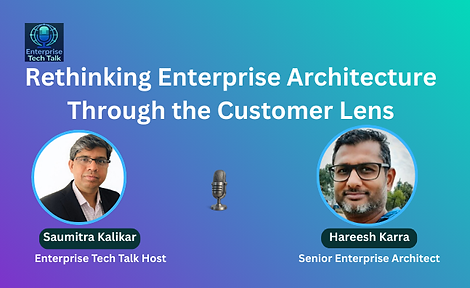
Rethinking Enterprise Architecture Through the Customer Lens - with Hareesh Karra
For years, customer experience was treated as a front-end concern — a better UI, a smoother mobile app, or a redesigned website. But in today’s digital-first world, that mindset is no longer sufficient.
Customer experience is now an end-to-end enterprise architecture problem.
In the latest episode of the Enterprise Tech Talk Podcast, I sat down with Hareesh Karra, a seasoned Senior Enterprise Architect, to unpack what customer-centric enterprise architecture really means — and why many organisations struggle to make it real despite years of investment.
The Customer-Centricity Paradox
Almost every organisation claims customer centricity as a strategic priority. Yet in practice, many enterprises are still organised around:
- Internal silos
- Legacy systems
- Fragmented data
- Technology-first operating models
As Hareesh points out, the gap is widening because customer expectations have fundamentally shifted. Customers now expect:
- Digital-first engagement as the default
- Trust in how their data is used and protected
- Low effort, fast resolution, across every channel
At the same time, organisations face increasing cost-to-serve pressures, regulatory complexity, and declining customer tolerance for poor experiences. This tension is precisely why customer centricity remains so hard to achieve.
The Mindset Shift for Enterprise Architects
One of the strongest themes from the discussion is that enterprise architecture must evolve beyond its traditional boundaries.
- Customer-centric enterprise architecture requires a shift:
- From technology standards to customer outcomes
- From application portfolios to customer journeys
- From abstract capability models to value-driven investment decisions
Instead of asking, “What systems do we need?”, architects must start with:
- What experience are we trying to deliver?
- Where are the moments of truth for the customer?
- Which capabilities directly enable those moments?
This reframing positions enterprise architects not just as advisors, but as active decision-makers shaping product roadmaps and business outcomes.
Why Value Streams and Journeys Matter More Than Ever
A particularly practical insight from the episode is the power of combining:
- Customer journeys
- Value streams
- Capability models
Many organisations already have capability maps — but they often remain static artefacts. When journeys and value streams are mapped to those capabilities, they become actionable intelligence.
This approach enables leaders to:
- Identify friction, duplication, and handoffs
- Quantify where technology truly adds customer value
- Prioritise investments based on customer impact, not intuition
It also changes the conversation with business stakeholders — from “What does this system do?” to “This capability directly underpins our most critical customer journey.”
Architecture Patterns That Enable Customer Centricity
From a technology perspective, the episode highlights a major architectural shift: the emergence of the customer data layer.
Unlike traditional data warehouses built for reporting, modern customer data platforms support:
- Near real-time, transactional engagement
- Omni-channel consistency
- Personalisation at scale
Combined with API-led, composable architectures, this pattern enables enterprises to deliver coherent experiences across channels — without rebuilding everything from scratch.
Measuring What Actually Matters
Another key takeaway is the need to move beyond NPS as the sole measure of customer experience.
More meaningful metrics include:
- Customer effort (time and friction to complete tasks)
- First contact resolution
- Trust indicators, such as data handling and transparency
Complaint trends, not just satisfaction scores
These metrics align far more closely with architectural decisions and provide tangible feedback on whether customer-centric design is truly working.
The Role of AI in Customer-Centric Architecture
AI, particularly agent-based and generative AI, emerged as an accelerator rather than a bolt-on capability.
The most immediate value is being realised in:
- Customer service enablement
- Frontline agent augmentation
- Workflow automation and orchestration
Crucially, AI works best when treated as part of existing value streams — not as a standalone innovation initiative.
A Practical Starting Point
If there is one piece of advice enterprise leaders should take away, it is this:
Start with one high-value, high-volume customer journey.
Map it end-to-end.
Understand the capabilities behind it.
Improve it measurably — then scale.
Customer-centric enterprise architecture is not a theoretical exercise. It is a disciplined, outcome-driven evolution of how we design enterprises for the customers they serve.
🎙️ Listen to the full episode of Enterprise Tech Talk to explore these insights in depth and hear practical guidance from real-world experience.
Subscribe to get the monthly podcasts, articles and executive decision briefs emailed to you, absolutely free. Unsubscribe anytime.
Episode Transcript
FULL TRANSCRIPT
This transcript is based on the episode’s English auto-captions and has been formatted for readability. Please allow for occasional transcription errors in names, acronyms and specialised terms.
[00:00:00]
So there's a significant pressure to drive the cost to serve down whilst improving the customer overall customer experience. So organizations that are able to understand these customer behaviors and respond and be ready to respond to those engagements are really the ones that are flourishing today. As an enterprise architect, we can identify where are the opportunities within our existing value streams. there is a real need to establish a unified customer repository. Most organizations are starting to um look at their core product value stream. So um be that insurance, so be that payments and aligning the architecture capabilities to those areas. Hello and welcome to the enterprise tech talk podcast. I'm your host Saumitra Kalikar. Now in today's digital world, the customer experience is no longer just a front- end design issue. It's a end to end architecture concern. Many organizations think that they're customer centric, but the reality is that their systems, data, and overall operating models are not necessarily organized for customer centricity.
[00:01:27]
So in today's episode, we will unpack what does a customer centric enterprise architecture look like, why does it matter, and how organizations can make it real. To join the conversation today, I have with me Harish Kara. Hares is a seasoned senior enterprise architect with wealth of experience in delivering customer centric enterprise architecture initiatives. So Harish welcome to the podcast. >> Thank you Tatra. Wonderful to be here. >> So Harish before we take a deep dive would you please provide um a brief overview about your professional career and what excites you to be in the enterprise architecture role? >> Yeah. No but thank you for that. Um so I've been in IT for a few decades. I'll put it that way. Um most of my time has focused around um the customer lens in one way or the other. from the early days of looking at uh the motor vehicle industry and focusing on the driver through to more recently in the health insurance industry where we're looking at the customer and more importantly as a member and how do we make sure that the overall health of the member is improved. Um, one of the things that I really found um, quite pivotal in my thinking was looking at it from the customer lens and understanding what is the moment of truth as we call it that is relevant and appropriate for that customer has made a significant change to the way we approach the problem. And it's not just about trying to use technology to solve it. And that's really what excites me, the change we drive for the customer. Um where technology is more of an enabler.
[00:03:16]
>> Okay. So let's let's dive in Harish. Um when I was doing some research for this um uh our episode um I noted down that almost 90% of customers uh say that they compete for customer centricity. So there that's where compet main competitive differentiator >> and we all know that customer centricity is not a new priority for businesses. Most of the organizations are um have been thinking about that for a while now right investing on that. But the fact remains that customer centricity still is a challenge become a truly customer centric organization still is a challenge right. So in your view what are those big challenges c u organizations face to to transition theself to to be fully customer centric organizations >> yeah um thank you good question so I'm seeing three key things that are driving the uh need for organizations to be more customer centric um first and foremost is digital first so customers are increasingly expecting to engage with organizations in a digital world, be on the mobile phone or on the website. Um, and they will really only, you know, want to engage with the organization if they're stuck and they'll pick up the phone or even that is quite limited.
[00:04:42]
The other u big shift is um customers want to know that the organization they are dealing with can be trusted can be trusted to look after their information and their needs. Um without that customers have no loyalty uh to stay with you and they will go elsewhere. Um and both of these have required organizations to pivot and make quite significant uh changes within the organization. And what this has meant is that the cost to serve a customer has increased whilst the tolerance for the uh service from the customer perspective has actually reduced. So there's a significant pressure to drive the cost to serve down whilst improving the customer overall customer experience and so this is why you know organizations are finding it really hard to become a customer centric because of these challenges and that that's what they need to overcome and they will have to do that by taking a customer first and digital approach.
[00:05:49]
>> Right. Right. And um the other thing is most is also about customer behavior. Uh if I if I say so because um we all know that customer behavior uh um is is changing. They expect more from most of the organizations and um there's a pressure or push from customers now onto organizations to make their services more consumable. Right. So um the what kind of key gaps you see with based on what customers expect and what organizations are not able to deliver. There's probably two main things um uh that customers are looking for. Um one is uh trust the the organization that we are interacting with. Do I trust them and will they trust and look after me? Two is around the the digital world. Everything is a digital first. So as a customer, how can I engage and interact digital first? So organizations that are able to understand these customer behaviors and respond and be ready to respond to those engagements are really the ones that are flourishing today. And that tends to be the challenge for a lot of the traditional organizations also. Um they're not able to pivot to a digital centric digital first approach because of their legacy investments. Um it does require a new way of thinking. Um trust, how do you integrate trust into a uh a platform? How do you respect customers privacy, their right for um how their data is used and handled? um these are some of the new challenges that organizations need to lean into and that is what's going to define the level of trust a customer has with an organization. >> So let's shift our focus harish to our the core topic of today which is the customer centric enterprise architecture.
[00:07:53]
Now traditionally customer um enterprise architecture has always been considered as a technology discipline right enterprise architects are responsible for core technology standards principles guard rates technical dates so on and so forth right but when we talk about a customer centric architecture in your view and your experience what mind shift shift is required for enterprise architects to start thinking about the the customer outcome comes. >> Um again um as our customers be that business and industry um are taking more of a customer lens and customer first approach. As an enterprise architect we need to better understand what are the capabilities that the business requires to uh meet that to I'll probably touch on maybe three key points there. one is what's the service experience that we want to have for our customers. So as an enterprise architect looking at the the the service capability that the organization delivers to its customers will allow us to understand the pain points and simplify the overall um customer service >> uh from the organization to the Um I think the other lens as an EA that we always need to keep in mind and and you know taking a business uh focus is one around what are the customer outcomes that we want to drive for the business not necessarily uh let's drive some cost out or reduce some risk uh as such but it's more around achieving and attaining our customer outcomes and how this translates is in form form of better customer journeys so that they have more um what I call uh exciting conversations and engagement with us.
[00:09:52]
They are um you know much more easily um addressed their pain points more easily addressed um as part of their engagements with us um and obviously less complaints. Um the third point um I find um that as an EA we need to do is um it it's more of a technology lens but every EA um has a responsibility to leverage their what assets they have today. Um most organizations have a plethora of systems and solutions that deliver more than often multiple capabilities across the organization. as an architect, how do we best leverage what we have? What are those shared capabilities that we need to be thinking about to help the organization accelerate? And so this translates into services such as identity. How do we ensure the customer we're talking to, you know, is the same, is the one customer as I refer to it. Um how do we leverage the data we have which might be spread across multiple areas within the organization?
[00:11:03]
um how do we ensure that payments you know drive security and trust you know we're not necessarily um um you know uh misusing the customer's data and their financial information so this is really where the EA comes to a head where they're able to bring the synergies of the existing assets identify what are those shared capabilities and drive that customer experience different differentiation >> yeah yeah so Harish um I'd also like to unpack what kind of tools and techniques um enterprise architects need to think of or adopt. Uh when we talk about the customer centric enterprise architectures uh because uh traditionally enterprise architects would focus on capability models um application portfolios etc. But when you're talking about delivering the the business technology road maps or um target architectures which are focusing on uplifting customer experience um what kind of additional techniques enterprise architects need to learn and adopt.
[00:12:10]
>> No that's that's a good good point. Um ju recently in in my previous organization um I found that having an awareness and and and well articulated uh capability map for the organization was not necessarily the answer but actually the foundation to helping us now look at solving the business needs. And what h what we did was once we've established that model we then focused on thinking about the customer journeys and so we started identifying what are the key customer journeys that are relevant um for our business and these helped drive the uh service blueprints for our capability modeling and how that worked is it allowed us to identify where are the operational steps and hence the opportunities for improvement, automation and or removal.
[00:13:12]
Um and ultimately this resulted in a mapping between the value stream, the value we deliver to our customers and by linking that value stream to the capability models, we were able to identify very quickly where can we immediately leverage technology and its capabilities to drive value. Where do we have gaps? And as a result, that alignment and mapping exercise allowed us to then very quickly come up with a set of key uplifts that we need to do within our uh capability space. And so from a tools and techniques perspective, we found the most valuable was this mapping of value streams to the journey maps and the underlying capabilities. So I know many organizations have capability models, technology, business capability models. Um my honest guidance would be to now actually turn that into actionable intelligence by mapping your process to that to really understand where your opportunities are.
[00:14:18]
>> Yeah. Yeah. So I that's a good point that value streams becomes a powerful tool um to really um anchor your conversation conversations with business because they they very well then understand the customer experience the the critical processes right and where the improvement opportunities are etc. >> Yeah. No, look and that's that's exactly what we saw the moment we started doing this work. It was quite an eye openener where the business started to see how the work they did was directly resulting in the customer outcomes that they wanted and they could easily see the technology investment that was underpinning their value streams. And so the business were not in a situation of um what really does that application do for us but it's a more of a case of I need that application because it absolutely underpins my claims my um core uh customer onboarding journey and so that was the big differentiation that we saw.
[00:15:20]
>> Yeah. Yeah. And in your experience, does that also become a powerful tool to uh to support or justify specific investment priorities as well? >> Yeah, exactly. So by identifying those opportunities matched to the value streams, we were able to then identify where do we need up. So those opportunities I mentioned, those are all investment opportunities. um we can then prioritize those investment opportunities based on the value of the customer gen and the value stream. So it was a very easy objective way of being able to help the business identify the opportunities and the value and effectively sequence that investment plan. >> Yeah. Yeah. It becomes very datadriven conversation and exercise if I imagine. Great. Um let's let's move to the the architectural patterns side of it right.
[00:16:19]
Uh when we talk about establishing more customercentric enterprise architecture um yes there are components of core systems uh etc. But uh there are certain patterns that you would think of when it comes to how you actually bring the data together because customer experience. A good customer experience you cannot deliver uh unless you have very good governance around your the data, right? Um the the other aspect to good customer experience in my view is how you make sure you have consistency in channel experience, right? The whole omni channel thing. So in your view um how how architect should think of those kind of patterns or richer patterns um to support that whole full customer experience story. >> Yeah. Um I think one of the big things we saw over the last five to seven years is the shift towards um a customer data layer. Mhm.
[00:17:20]
>> What that was one of the biggest patterns that we saw or compared to your traditional you know uh distributed architectures um and and all the previous patterns. Traditionally we would look at customer data as some kind of a uh data warehousing kind of problem. you know, we need to bring all the customer records together in one place, aggregate it, and we now have this view. The digital first approach and and and the more recent advancements have meant that there is a real need to establish a customer a unified customer repository that supports transactional behaviors. So our digital our core operational platforms in a more near realtime manner in the moment to support those engagements rather than your traditional data warehouse model. And so this has started to create and effectively um morph into the data warehouse into a more operational data layer which traditionally is now called um a customer data platform or a customer data layer. What this represents is effectively a unification of the customer data.
[00:18:35]
Um I want to be careful that um it is quite hard to get to the one customer view. I mean that is a bit of a utopian sense. Um we'd all like to know exactly who it is that we're talking uh to at any point in time. This customer data layer helps bring together all the different signals, the the the uh small pieces of information about who we think someone is based on, digital signatures, cookies, and so on, login details, and all of that to help build that unification. And so what we're finding is that for us to be able to serve our customers and we go back to our you know an experienceled approach. How do we influence the customer journey a customer data layer that supports the transactional the in moment operational behaviors and engagements the customers having has become really critical. So as a technology pattern allowing and creating that layer has been one of the biggest game changers. Now that doesn't take away some of the other aspects around um you know we still continue to have uh a composible architecture requirements and that just continues to mature. Um there's an API approach to ensure that all of the services that we have with our core platforms our information repositories including things like our customer have um services based approach and and and then we are able to compose the the and and build those microservices. So those still you know continue to evolve. Uh but the biggest pattern difference I saw was this creation of this customer data lake to help drive that uh digital engagement. >> Yeah. Yeah. Yes. That's true. Um so and and that becomes a core platform I would imagine for driving overall personalization strategy as well. And um and you you mentioned our omni the the microservices the APIs etc. as as you standardize those um that drives the omni channel experience as well, >> isn't it?
[00:20:37]
>> Yeah. No, that that absolutely one of the key prerequisite for um organizations to think about an omni channel. >> Yeah. Yeah. Okay. um the let's think of let's talk about the governance aspects of uh architecture to to make it um to ensure we deliver much more customercentric outcomes right um traditional governance architectures when you think of those are heavily focused on standards guard rails etc which are important absolutely right at the end of the day you want to mitigate the risk uh of of any technology change right um but when you start thinking about customer centric outcomes. What are the additional factors come to your mind that architecture governor should take into consideration? I think the other shift that we have seen over the last 10 15 years is uh in the architecture space is moving from a centralized model into uh a more of a a distributed or federated model. Um and more recently that is also further evolving into a product aligned uh architecture model. Um how does this uh uh materialize? So most organizations are starting to um look at their core product value stream. So um be that insurance. So be that payments and aligning the architecture capabilities to those areas within those uh products.
[00:22:09]
That then allows those architects to focus on the key value streams. Again going back to what we talked about earlier, the customer journeys and the value streams that's are required in within that product space and as a result understanding what are the technologies and the capabilities that support those value streams. So the really architects are starting to get more um uh focused in in those kind of areas. Not to say they're going to become a technology specific domain expert, but it's more around the business product and value stream alignment that we're seeing more of um as a model. Um look and and the other uh change is um the architectural role continues to evolve um as part of this customer centricity is we traditionally have been advisers. We are starting to see that architecture is now part of the decision making group and where that materializes is in terms of helping understand the trade-offs. Um, one of the big challenges any organization or any product development uh that will go through is understanding the the risks and the trade-offs that they need to make in order to go to market within a certain uh period. And so the architect really comes into a head where they're able to balance the business needs with the technology requirements and the challenges and the duration and the complexity to guide that decision as a collective. So I think that's one of the other big things that we I've seen around where from a governance perspective the architects are working with the business handin glove to then make those pragmatic decisions for the product uh roadmap.
[00:23:55]
>> Yeah. Yeah. And as it also means that architects need to in my view architects need to be more aware of um the first thing is um key uh customer experience measures that organization is tracking and how certain technology changes will actually deliver to those measures as well. Right. >> Yeah. No, absolutely. Yes. >> Okay. Uh so let's discuss a little bit about the the future the the emerging technology trends, right? We all know that AI is becoming big. Um in particular, agentic AI is going to offer new ways of working and potentially new um channels for customers as well. Right? So in that context, how what do you think um how enterprise architects should approach um um accommodating um these new technology trends within their organizations um and providing adequate guidance to the business as to how investment should be done to deliver new customer experiences around AI?
[00:25:05]
>> Yeah, look um AI is definitely the buzz word. So totally understand uh your question and why our audience would be keen to understand um where it fits. Um from a customer experience perspective again some of my recent work um I was lucky enough to take on that challenge to understand how can we introduce inject and leverage AI um within the organization. Where we saw that was in a couple of points. Um one was a mind shift mind shift around AI is not some new additional add-on capability that's going to solve a new problem. Um, in fact, we see AI as part and parcel of the existing capabilities just an acceleration or a maturity level increment. Um there is an overarching uh view that um we people are now starting to treat AI as another channel. Um and the thought process around that is how do we use that to increasingly deliver service using AI agents and uh and assistant and this is where that agentic AI really comes to a head. So going back to some of my past experience where we saw some of these shifts come together is um uh in within our customer service space. So be that frontline agents um in a retail or on a call center scenario.
[00:26:33]
Um we saw that the biggest impact and improvement AI could deliver for an organization quickly is within those areas of customer service. Um, not only is it around taking uh low value work out of the equation, um, but also about helping our agents um, our frontline staff um, better support our members and have richer conversations and for us our agents to do that, that means we equip them with the right information. So this is where AI was the second uh, layer providing that support. um and and guidance to our frontline staff uh at each step of the journey. So um I think AI is definitely going to make a significant impact there. The other area um as I mentioned uh low value work um we by looking at AI as another channel we were able to uh identify those lowhanging uh or low value work I should say for workflow orchestration and automation and that allowed us to actually remove uh work from frontline from our digital and actually have it dealt with um through the AI agents and the automation accordingly. So this is some of the ways in which as an enterprise architect we can identify where are the opportunities within our existing value streams. Um how to remove it for our members uh sorry for our frontline staff and and improve the productivity whilst delivering greater customer experience using AI. So um those are some of the key things that we found from an AI perspective.
[00:28:13]
>> Yeah. Yeah. And we we touched little bit on on the on how we should be measuring the customer experience. But uh as we as organization starts moving towards customercentric enterprise architecture um >> what are the key key metrics or KPIs um enterprise architects should be mindful of um while while making the conversation or providing a very clear road maps around customercentric um architectures. Yeah. No, that that's a good one and again um I'll anchor back to you know the value streams conversation and the customer journeys. So um one of the key challenges we faced was traditionally yes customer NPS was the one we all track to uh increasingly that is no longer enough because that is quite a macro representation that it didn't do justice to the level of change and the improvement we wanted to track and and improve on. So over time some of the other metrics that we've started looking at um uh in and again aligned to our customer outcomes broadly revolve around the c the effort resolution and trust and what I mean by that is how much time does a customer spend completing a transaction like an address change and so on how easy did we make it so if they spent 30 seconds that must be pretty good if they spent 5 minutes changing an address something's wrong in that so something really tangible like how much effort a customer has spent completing a transaction. Um from a agent perspective um from a frontline agent perspective um we've looked at uh what we call first contact resolution.
[00:29:53]
You know traditionally it was um um very much around how long how quickly did you resolve the customer to more of did we resolve the customer in the first. So, it's it's a subtle change, but what it means is that whoever you've talked to as a member, that agent has all the information and the ability to serve you and resolve it right there and then without handoffs. And that's a big thing because handoffs tend to create a lot of friction. So, first contact resolution is is one of the other metrics that we've talked about. Um and of course there's some of the other ones around complaints um that that also tends to uh be a good indicator uh on um customer outcomes and whether um the customer service the customer centricity has improved. >> Yeah. Yeah. Yeah. That's a good thing because um most most of the organizations only focus on NPS but there are so many other ways you can actually track the the customer centricity and improve those.
[00:30:57]
>> Yeah. Yeah, I think we are we are nearing time end of time. But if I ask you one one question, Harish, if you are having conversation with let's say the chief architect or with with the CIO in your organization and you want to pitch for the um for shifting the enterprise architecture function more towards customercentric one. What what are the key guidelines guidance you would you would provide to provide to them? Yeah. Um, I'd probably say start with one high value, high volume customer journey. Analyze it, map it end to end. Understand the capabilities that underpin it so that you know where you need to focus your efforts on. And that will drive your opportunity investment plan to improve that journey, customer journey. And I think that'll allow an innovative mindset. You can measure your impact very quickly given the high volume and then roll out additional uh customer value journeys accordingly. >> Right. Yeah. Yeah. That that's a good good um uh positive path forward because you can demonstrate a win and then you can build on top of it later. Right.
[00:32:21]
Cool. Um >> yeah. >> Yeah. So thanks Harish uh thanks for your for for your insights. Uh I think there are few key messages for and insights for our audience. Uh particularly I really like the articulation and emphasis on value streams. uh if you are actually moving from a traditional enterprise architecture function towards a more customercentric ones various streams and customer journeys to um to to that effect al become very powerful tools and techniques to articulate u uh how enterprise architecture should evolve. Um you also talked about uh different types of metrics uh beyond NPS right and how the these metrics should be tracked to deliver um uh c value to the customers and track the majority of customer experience uh and improve on that. So thanks for that. So it was >> thank you Harish and thanks thanks for your time again.
[00:33:20]
>> No I appreciate it. Thank you. >> Hope you like today's episode. Please subscribe us on YouTube, LinkedIn and X platforms. Also, if you are passionate about any such enterprise technology topics and want to participate in the discussion, please reach out at inquiry@ enterprisette.com. Also, please visit the website www.enterprisete.com Enterprised.com for more details.