
Now Subscribe to Enterprise Tech Talk Monthly Edition to
get new ETT podcasts, selected articles and Executive Decision Briefs in one monthly email.
Subscribe free. Unsubscribe anytime
Enterprise Technology Expert Articles
Executive articles on AI, cybersecurity, cloud, data, enterprise architecture, digital sovereignty and technology strategy for business and technology leaders.
Enterprise Tech Talk expert articles examine the technology shifts shaping modern enterprises, from agentic AI and digital sovereignty to data governance, cybersecurity, cloud strategy and enterprise architecture. Each article is written for CIOs, CTOs, CISOs, enterprise architects, digital leaders and senior executives looking for practical, strategic perspectives beyond the hype.

Technology Debt Is Strategy Debt: Why CIOs Must Treat It as a Board Level Risk
Saumitra Kalikar
3 Oct 2026
Technology debt is not just a technology problem. It can constrain strategic choice, slow transformation and weaken AI readiness. This article explores how CIOs can identify known, emergent and latent debt, and move from reactive remediation towards proactive debt management.

Technology Regulation vs Innovation: How Enterprises Can Adapt
Saumitra Kalikar
6 Sept 2026
As technology regulation expands across AI, cybersecurity, data sovereignty and operational resilience, enterprises face a growing challenge: how to strengthen governance without constraining innovation. This article explores why regulatory capability should be proportionate to an organisation’s risk and operating context, and how regulatory adaptability can become a strategic advantage. It provides a practical five-step agenda for executives to balance compliance, technology flexibility and sustained innovation.

Organisational Velocity: The Next Competitive Advantage in the AI Era
Saumitra Kalikar
9 Aug 2026
Organisational velocity is emerging as a critical source of competitive advantage as AI, shifting customer expectations and intensifying competition accelerate the pace of business. This article explores how high performing enterprises convert change into value faster by improving decision making, capital mobility, operating models, technology architecture and organisational learning. It examines why AI can accelerate enterprise velocity, but cannot compensate for structural friction across leadership, governance and execution. For CIOs, CTOs and senior executives, the article sets out practical actions to build a more responsive, adaptable and high velocity enterprise without compromising resilience or control.

Product, Platform or Capability? Resolving the Operating Model Confusion in Enterprise Technology
Saumitra Kalikar
11 July 2026
Enterprises are confusing products, platforms and capabilities. This article explains how CIOs, CTOs and senior leaders can clarify ownership, funding, platform engineering and operating model design in the AI era.

AI & Digital Sovereignty: Why Nations and Enterprises Are Rethinking Technology Dependencies
Saumitra Kalikar
28 June 2026
AI and digital sovereignty are no longer just policy or data residency topics. As AI becomes embedded into enterprise decision-making, operations and customer interactions, technology dependency is becoming a strategic resilience issue. This article explores why nations and enterprises are rethinking their reliance on global cloud, AI models, data infrastructure and software ecosystems. It argues that sovereignty is not about isolation, but about visibility, control, optionality and the ability to recover when critical dependencies change.
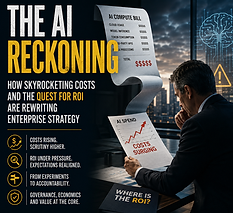
The AI Reckoning: Why Enterprise AI Is Entering Its Accountability Era
Saumitra Kalikar
31 May 2026
Enterprise AI is moving from experimentation to accountability. This article explores the practical challenges facing CIOs, CTOs, CDOs, CISOs and boards as they work to prove ROI, strengthen governance, manage AI costs, secure data, and scale AI responsibly across the enterprise.
It also examines why many organisations are finding the shift harder than expected, particularly where fragmented data, legacy architectures, weak controls, and unclear ownership slow progress. For technology leaders, the real challenge is no longer access to AI, but building the operating discipline needed to make it reliable, secure, and economically viable at scale.

The Governance Paradox: How Federated Enterprises Scale Without Losing Control
Saumitra Kalikar
3 May 2026
This article explores how modern enterprises can balance autonomy and control in increasingly decentralised, product-led operating models. It outlines a federated approach to technology governance that aligns architecture, data, security, and investment decisions without slowing down delivery. The focus is on shifting governance from centralised control to embedded guardrails, platforms, and shared accountability. It also provides practical recommendations to help organisations scale innovation while maintaining coherence, risk discipline, and strategic alignment. Ultimately, it reframes governance as an enabler of speed and enterprise value, not a constraint.

The Death of the IT Project: Why Everything Is Becoming a Product (and Why Most Enterprises Still Get It Wrong)
Saumitra Kalikar
19 Apr 2026
Most enterprises claim to be shifting from projects to products, but few have truly changed how they fund, govern, and measure technology. This article challenges the superficial adoption of product thinking and exposes the structural gaps that hold organisations back.
It offers a clear, executive-level view of what a real product operating model looks like, where ownership is end-to-end, governance is embedded, and value is continuously delivered, not just planned.

AI-Native Enterprises: Rethinking How Organisations Operate, Compete, and Decide
Saumitra Kalikar
7 Apr 2026
A practical, executive-focused exploration of what it means to become an AI-native enterprise—moving beyond pilots to fundamentally redesign how decisions are made, operations are run, and value is created in the age of AI.

From Platforms to Ecosystems: The Future of Enterprise Architecture in a Connected Economy
Saumitra Kalikar
23 Mar 2026
Discover how enterprise architecture is evolving from platform-centric models to ecosystem-driven design. Learn key trends, real-world examples, and strategic implications for CIOs and enterprise architects.

Enterprise Architecture in the Product Operating Model: Reinventing the Architect’s Role
Saumitra Kalikar
10 Mar 2026
As organisations adopt product operating models, the role of Enterprise Architecture is evolving rapidly. Traditional architecture approaches built around centralised governance and project oversight are no longer sufficient in environments driven by autonomous product teams. This article explores how architects can reinvent their role by focusing on platform strategies, architectural guardrails, and strategic influence. It highlights how modern architecture can enable faster delivery while maintaining enterprise-wide coherence and long-term technology alignment.

Digital and AI Sovereignty: Why It Matters for Australian Enterprises in 2026
Saumitra Kalikar
6 Mar 2026
Digital and AI sovereignty are no longer policy talking points. They are now core to enterprise resilience, competitiveness, and national continuity.
In this article, Saumitra Kalikar explores what sovereignty really means for Australian boards and CIOs, and how to design AI capabilities that are innovative, secure, and aligned to our legal and societal foundations.

Leading in the Age of AI: Why AI Leadership and Operating Model Discipline Are the Real Competitive Moat
Saumitra Kalikar
22 Feb 2026
This article argues that in the Age of AI, competitive advantage no longer comes from access to technology, but from leadership quality. As AI capabilities commoditise, the real differentiator becomes how decisively and responsibly leaders mobilise their organisations to adopt, govern and continuously improve. It outlines practical shifts in operating model, decision cadence and risk posture required to compete effectively.

Composable Enterprise Architecture: The Executive Blueprint for Agility, AI Readiness and Regulatory Resilience
Saumitra Kalikar
18 Jan 2026
Most organisations want agility. Few are architected to afford it. When change is slow, costs rise, and risk compounds, the issue is rarely delivery. It is architecture. Composable Enterprise Architecture is not about tools. It is about designing for change without enterprise-wide disruption. When capabilities are modular, contracts are clear, and governance is embedded.