
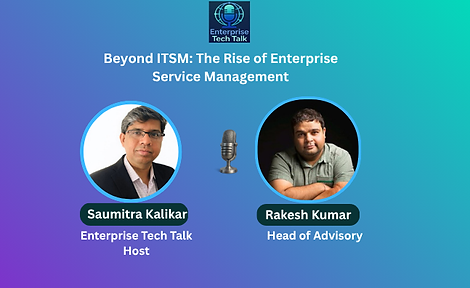
Beyond ITSM: The Rise of Enterprise Service Management - with Rakesh Kumar
For years, service management has been something most organisations associated with IT.
That model is no longer enough.
As enterprises scale and digitise, employees expect a seamless experience across HR, IT, finance, and other services. They do not think in terms of departments. They expect the organisation to work as one.
This is where Enterprise Service Management (ESM) is starting to play a critical role.
In a recent Enterprise Tech Talk conversation with Rakesh Kumar, we explored how organisations are extending service management beyond IT and using it to unify enterprise operations.
What stood out is that ESM is not just about improving service delivery. It is about creating a connected operational model where workflows, data, and services come together.
When that happens, the benefits go beyond employee experience. Organisations begin to see improvements in productivity, better visibility into operations, and opportunities to simplify their technology landscape.
More importantly, ESM creates a consistent data foundation. This becomes increasingly valuable as organisations look to scale AI and automation across the enterprise.
Of course, the challenge is not technology. Most organisations already have capable platforms. The real challenge is aligning departments that have traditionally operated in silos and bringing them onto a shared way of working.
That is why the most successful ESM initiatives are not positioned as IT programs. They are driven as enterprise transformation efforts, often with strong executive sponsorship.
Looking ahead, as AI becomes more embedded into enterprise workflows, ESM is likely to play an even more important role. It provides the structure and consistency needed to make AI effective at scale.
For leaders, the question is no longer whether ESM is relevant. It is how quickly they can move beyond fragmented service models and build a more unified approach.
👉 How is your organisation thinking about service management today — still within IT, or evolving toward enterprise-wide ESM?
#EnterpriseServiceManagement #ITSM #DigitalTransformation #CIO #EnterpriseArchitecture #AI #FutureOfWork
Subscribe to get the monthly podcasts, articles and executive decision briefs emailed to you, absolutely free. Unsubscribe anytime.
Episode Transcript
FULL TRANSCRIPT
This transcript is based on the episode’s English auto-captions and has been formatted for readability. Please allow for occasional transcription errors in names, acronyms and specialised terms.
[00:00:00]
Service management should never been have been a concept restricted to IT. Um service management it at its core works with fundamentals that can be applied to any service. >> That's where it's very important that enterprise service management discussions are created at CEO level because that's where CEO would be able to bring the departments together and say this is what we're looking for. How we make sure that organization knowledge, organizationwide data is usable for next steps of evolution for the organization and that's where the actual value of enterprise service management comes at 30 to 50% productivity gain is usually communicated as a uh I would say end objective for any ESM platform implementation. How we make sure that human and AI work in tandem. >> The on the process for onboarding AI and the process for onboarding a human are very different.
[00:01:20]
Hello and welcome to the enterprise tick talk forecast. I'm your host Sumitra Kalikar. Now for many years the practice of service management has largely been confined to IT functions within the enterprises. But now this is shifting. uh we are seeing the uh the principles of service management are being increasingly extended to other corporate functions such as HR and finance and and and so on and in many ways that is redefining how enterprises deliver all their enterp internal services and operate at scale. This is the focus of today's conversation. Um, the rise of enterprise service management. Uh, and to help me unpack this interesting topic, I'm joined today by Rakkesh Kumar. Rakkesh is the head of advisory at Inorphice. Um, Rakkesh has deep experience in enterprise service management implementation and transformation. So, Rakkesh, welcome to the podcast.
[00:02:18]
>> Uh, thank you very much Amitra. It's a pleasure to be here and speak with you. uh uh obviously the topic is very interesting and we look forward to have it in u much uh unpackaged I would say so that uh everyone understands in understands it in a simplified manner rather than the way industry has complicated it many times. So uh obviously looking forward to this discussion um which is going to be uh largely focused on how we perceive enterprise service management, how IT service management has evolved into enterprise service management and what it actually means for the AI world. Uh if you if we you want to use enterprise service management 5 years down the line, what it should actually mean? >> Exactly. Okay, these are some of the important points I'm definitely interested to unpack with you Rakkesh. Um, so but before we get started um so you have deep long experience in the in this industry service management industry as you said right from IT service management now emerging in uh evolving into enterprise service management. So maybe to get started would you provide a brief overview of your journey into this industry and how you have seen this industry evolved over the years?
[00:03:37]
>> Of course. Of course. Um so uh overall u 20 plus years 20 nearly 21 years in this industry I've seen the journey growing from very focused IT service management which was primarily limited to incident problem and change for infrastructure uh uh services. Um I've seen it growing from there to a phase where large it it it transformed into a um outsourcer integrator service management as an outsourc or outsourcer integrator. Now that's that's where the concept of service integration and management popped in and it became a huge buzzword um 3 four years ago 3 four years ago. It's it's still a good uh concept to have but I think as it has evolved now enterprises are not just looking at service management from IT perspective u they have started seeing as it is it it has one large platform based uh service management that integrates all the services that business is looking for or business is actually um working with.
[00:04:54]
Now what is it what it essentially meant for me uh in my journey was when I started as uh uh data center uh operative then I moved to managing data center and then uh from other in my different roles uh I moved to process consulting and then finally in my last 8 n years or in fact nine years I've been working up working in setting up practices for service management related uh capabilities. So in that sense I have uh been able to uh work with skills work with the uh industry changes which are not confined to uh service management related uh I would say terms. Uh initially it was it started with the the the typical ITL that we talk about it is the uh core of service management per se. uh when it started uh way back when I started my journey in process consulting or service management consulting it was ITL V2 and V3 uh since then uh the perception of people on ITL has changed perception of businesses on ITL has changed uh there was a time where people stopped believing in something getting delivered through ITL because they thought it's too much governance and too much um uh uh process uh uh but it the idea evolved and obviously the thought process of businesses also evolved and with with with that uh when you're creating capabilities in the organizations you have to develop on new offerings new frameworks new way of working with domains so banking would have a different mindset um hospitality would would have different mindset >> so all these areas need very specific way of looking into service management you cannot just have one silver bullet for all.
[00:06:52]
>> So post um the era of I would say IDL ITL still is ITL is still alive. I'm not saying it's dead but post the era of where it was the primary go-to framework service integration management has come in after that now once the outsourcers are integrated people still feel that there's a need of common platform to bring all the services together and that's where enterprise service management has picked up as one of the one of the key talking uh topics and or I would say a discipline that every organization or every big business looks looks for. >> So that's a good good um kind of context and history to service management. Um service management as a concept is well understood within the IT, right? Uh it's there for for a long time. If you talk to CIO, CIOS will get it. But uh as ESM is now crossing the boundaries, right?
[00:07:56]
um getting into the wider uh business uh operations. How do you um uh articulate ESM as a concept um to nonIT executives? >> For me, service management or IT service management should have uh never been or service management should never been have been a concept restricted to IT. Um service management it at its core works with fundamentals that can be applied to any service for that matter. be it HR, be it finance, be it legal, anything. Now, uh when we speak with any of the customers who have experienced it service management but are still thinking of moving into enterprise service management, I think the key talking point becomes you have everything that is needed uh as building blocks in terms of IT service management. Why not evolve it to different departments and unify them as a common platform or common um organization framework for your services to run. Now one of the key benefits that you have to talk about is that uh first of all there would be normalization of data. Normalization of data in in huge sense uh same people data gets utilized by finance, HR and uh IT but when we are segregated them we are working with them in silos separately we are just creating three data banks and in the inconsistency um is is everywhere. Uh when we do that when we do enterprise service management way of working uh or when we adopt enterprise service management way of working we are actually creating a common data pool for all the services to utilize the update become updates become very consistent uh the usage of data uh is is I think more reliable uh and when we when we talk about AI in that context I think uh rather than just ITSM uh the data residing in ITSM uh when compared to data residing as an ESM platform as in an ESM platform makes more sense to create your own LLM and work through uh uh AI models your knowledge that you create uh for let's say it in IT service management system when you get married when when get married when gets married to uh financials is financial management and HR management it creates a huge value uh how the personas behave uh because at the end of the day IT service man be it IT service management be it uh financial management be it HR management it is addressing the personas of employees right >> and uh there should not be three different ways of working through those personas in three different departments >> uh It actually elevates the experience employee experience to a great extent if they get a similar experience across the services be IT be it HR be finance and enterprise service management quite does the same right it it it brings you on the same platform the same set of services and when you start talking in the same way the employee thinks okay this is the organization I'm working for there are no different teams I'm working for the organization there's Common way of interacting for services, common way for onboarding, offboarding, getting my laptop done, getting my pay slips generated if there is some error, correcting some uh financial things, everything through same portal, same way of interaction. So when when the CXOs u discuss this uh uh with us, it's primarily this value proposition we give it. Now another important aspect is sumra which I think is very important to and CFO are three different entities as an IT service management uh I would say owner uh which would be a CIO it's very difficult for me to talk to CHRO or CFO and say take my standards on take my way of working on that's where It's very important that enterprise service management discussions are created at CEO level because that's where CEO would be able to bring the departments together and say this is what we are looking for. So if if uh as as a strategy I would like to talk to CIO first but I would like to CEO for enterprise service management rather than uh just going to u being a proponent of IT service management being a proponent proponent of ESM I have to go one level up and that's where I'll able to convey the value better. Yeah.
[00:12:54]
Yeah. That's an important really good point you mentioned. Um and so look and and when you talk to the those CIO peers like the CFO or who other uh others um how do you I mean you need to sell the the need the case for enterprise service management to them at the end of the day right they need to be convinced. So what are the uh problems in their traditional operating models that you typically see and potentially bring on the table for discussion? That's one thing and second thing is uh at the end of the day uh to create a quantifiable business case a quantifiable benefits to the organization. M >> do you see what is the primary kind of argument or uh driver for these kind of investments? Is it mainly employee experience or also you also talk about productivity and efficiency those kind of other benefits as well.
[00:13:59]
>> Right? So uh coming to the first question first um >> the value that we see in enterprise service management is huge when we go beyond the uh context of traditional service model right the traditional service model is you have a customer uh which is internal for let's say HR and you have a set of capabilities and you utilize those set of capabilities to create services or create offerings or create work uh to be delivered to the your end customers. Now uh when the IT and when the technology is converging or let's say IT service management is converging to enterprise service management um the employee experience becomes core to it. um a person who is holding a mobile phone u would not like to open three different apps for HR um finance and IT if they want to log a request so you're right employee experience is one of the key selling points for any enterprise service management discussion but if you look at it strategically which is I think this is more tactical in nature when you talk about employee experience employee experience is a core to everything that every department does but from enterprise A service mind perspective this becomes practical. What strategic is how we make sure that organization knowledge organizationwide data is usable for next steps of evolution for the organization and that's where the actual value of enterprise service management comes in.
[00:15:37]
Uh finance data, HR data and IT data when combined together they create a tremendous value. anyone uh any um automation any artificial intelligence built on top of that data would actually propel the organization to a very u in a in a very fastpaced manner to next level. So that's a point we try to convey to the CXOs that you are creating a stepping stone for your next level of evolution by moving to enterprise service management and once that is set in uh in the heads of uh CXOs they obviously become interested because as I said right employee experience is key but it is very tactical in nature. Everyone talks about employee experience. So what kind of use cases do you typically uh highlight at which maybe business CEO or CXOs have not thought of so far but just bringing that data together right the pro the services together >> you as you said you can innovate into a next stage of um stage for your organization so what are those additional use cases uh those would be enabled >> so I the use case I'll talk about is very basic but it's very important right So let's say an employee is getting onboarded right >> now the journey of an employee in an organization starts with an HR system.
[00:17:04]
>> So the HR system would um interview there would get scheduled uh there would be a way interviews conducted scoring the selection this process usually sits in a system which is handled by a talent acquisition team. Now once the person is selected the the next team takes over is the the generation of appointment letters and uh onboarding the u once the offer is accepted onboarding the employee into the system that's that's usually a different kind of system. So talent acquisition system is separate uh u managing the employee life cycle in an organization is separate and the third system that gets triggered is a financial system. So the same employee is passing through three different systems which is uh uh acquisition uh HR for onboarding and then finance. Now everywhere everywhere in the business use cases I've seen none of the systems is isolated from it. So HR also uh wants the user to be created in the systems in the uh for the employee to work through work with email ids to be created that gets triggered at HR. Now once uh the employees onboarded there would be a request request for uh laptop there would be request for connectivity uh there's also a facilities management part of it right which comes in between where you allocate seats to uh uh the employee uh the area to work if there is a need for a desktop the desktop is created uh or provisioned for that particular uh employee and obviously once this provisioning has happened.
[00:18:48]
Employee has to be introduced to a system where he can report issues. He can log something that has gone wrong with HR or gone wrong with finance maybe pay slaves offer uh amount whatever and then obviously it >> is where my laptop is not working. Now conventionally we've been talking about only ID that something goes wrong raw login request login incident and ID but now if you look at it right the journey the whole employee employee when enters the organization until let's say 2 years down the line working if he's interfacing with the same system everything he's inputting or everything he's creating is uh getting logged into the same system in case of ESM it's not getting logged into multiple systems now this knowledge is can be utilized to create SOPs which can be converted to uh bots. This knowledge can be uh utilized to uh create better processes, improve better processes, shortening them uh why to go through this whole cycle when automation can happen, right? This whole cycle takes 5 days unless I have a comprehensive view of the whole process.
[00:19:59]
It's very difficult for me to reduce it from 5 days to 2 days or 3 days or 1 days. So I obviously get this perfect view when I start doing it in ASM way. The important aspect we have to understand is that when we talk about ESM as a concept, it can never be understood or uh practically implied without the concept of platform. >> Okay. So we'll not be able to do enterprise service management till we have a platform that marries everything together. Right. So uh and eventually when we see this whole life cycle getting managed through single platform the platform itself becomes a source of data for next uh level of work. >> Yeah. Yeah. So building on that because that was my next question. Anyway, um I think it's time to maybe unpack the concept about ESM as a platform a bit. um what kind of capabilities let's say support self-service portal or service catalog or some data management capabilities etc. what are those those few important cap capabilities um that ESM as a platform offers which actually brings this everything together >> right so when we say ESM as a platform uh we essentially talk about vendors right so who who's bringing that platform up so each platform essentially be it service now be it uh BMC be it any other platform right there's so many players in the market who bring that those platform capabilities >> I I think the essential capabilities remain at the core of platform which means how is there is a data model is there a data model in the platform that can ingest the data from various sources >> and make sense out of it. Can it create can it help you create workflows that can span across uh departments uh removing those silos and third being can it provide a com a single uh pane of glass view for each and every service that the employee is expecting which is essentially the employee experience part of it. Um uh obviously uh business analytics has improved over a period of time and there is huge um I would say huge uh automation in the way we used to work 10 years ago and now but where single platform holding whole of information the CIOS CX C HRO's and CFOs and at the end CEOs they'll be able to give get a very clear view of the bottleneck X in the system and uh the issues which need priority resolving this view should be a capability of the platform. So um if I if I just uh narrow it down, it should be a common employee experience which is through portal. Then a a very sound and uh uh what should I say robust data model that can actually uh take in ing inest data from various sources and uh make them into databases which are usable by the whole platform itself. Mhm.
[00:23:19]
>> And last but not the least uh analytics capability on top of it which can bring sensible information to the people who are looking to improve the overall system and platform. I think these three core things make uh a good ASM platform. Now again um workflow uh creating a workflow through various departments >> or various teams in the organization um it's it's it's one of the core things but it is a capability that can be enabled in various different platforms. Uh what makes it enterprise is the core data management ability underlying. >> Yeah. Yeah. Okay. No that's good. Um so let's talk about um some of the practical challenges which uh potent and I want to get your views on how you based on your experience again how you actually encountered those and then um try to mitigate those right so the the ch practical challenge would be uh yes ESM is really a good concept u but uh most of the organizations would historically have invested into siloed technologies and typically um it would have implemented in IT service management platform service now remedy as you said or whichever um finance would have their own finance systems uh HR von and HR systems etc. So um with those investments how do you if this is a new platform you want to establish as cross corporate functions how do you go about it um in terms of scaling the transition to a centralized platform >> right I think well let's talk about the challenges first the key challenges we usually come across is and I think it's one of the biggest right no matter whatever technology you feel like adopting uh in an organization the same challenges comes the same challenges come uh it is it is people working in silos and organizations failing to break those silos >> so uh even though it it's it's more a philosophical thing but I would say it is the biggest challenge practical challenge as well um in in my past experience I've gone to organizations where IT service management when goes to HR for data uh or let's say they want to integrate the two systems. The very first thing comes as a question is how are you going to use my data?
[00:25:55]
>> Uh what are you going to do with my data and um what is written for me? What what is in it for me? Right? While this mindset is very siloed, right? It it doesn't talk about how the enterprise is going to benefit from clubbing the whole things. But this mindset is a big problem in few of the biggest of organizations I would say. So obviously a a a good automating change management strategy has to be very much implied or applied whenever we doing an ASM initiative. Uh as I said it cannot just be CIO, CHO or CFO uh job. It has to be a CEO initiative which gets pushed across the uh departments and that's where I think top down approach can bring in a very smooth transition. Now second is uh which is more technical in nature. The challenge which is technical in nature the way data is maintained in each of the organization uh in each of the departments. Some of them are working in working with tools some of the working with excel sheets. Some of them are working with workflows automation. Now um as as a person who goes in and tries to implement enterprise service management the starting or the baseline is very staggered right it's it is somewhere it's very mature somewhere it's very immature. So I think the challenge first comes in getting that cons uh you have to get consult uh the organizations you have to work with them to uh come to a common data set which or common or a workflow which can utilize that data in whatever form it is and evolve and mature it over a period of time so that at least by uh 6 months or so everyone comes to the same level and they start interfacing and interacting um in a much seamless way. So it cannot be a journey of 2 months transition or 3 months transition. Uh obviously if the uh if the data lying in various departments is is of v variety is a different uh way it has been captured time taken is more but once it is done I think the result is everyone to see uh output is everyone to see that everything is becoming very smooth. Now the selling proposition also comes from the same fact right if if I'm able to convince the CEO that you would have a better visibility into your operations bottlenecks u um any interventions that you need to make through CHRO CEO CXO any CXO any regulatory compliance that needs to be applied I think this is an important factor we did not discuss right um ESM as a whole as a platform brings and better compliances because in a way the data inconsistencies are removed once we have that core uh data model being set into ESM and the data remains the same uh whether utilized by all the departments. So a huge push to compliance uh is provided by enterprise service management and that helps is a big selling point for uh industries like BFSI um and for the telecom as Telecom and BFSI are very heavy on compliance for that matter every in every domain is right even life sciences and healthcare is also very uh keen on compliances. So this becomes a very very good selling point for them and if we are able to convey that message clearly I think it becomes easy for organizations to adopt it accept it rather than adopt it. I think compliance is a really good point that you mentioned. I I um so I know based on my personal experience in Australia uh most of the financial industry uh um companies they are they have regulatory obligation for um third party risk management for example and few other compliance obligations which requires those specific compliance controls controls controls objectives well defined monitor tracked etc and bringing all the data together under same platform form really helps. Uh uh so compliance could be one key driver.
[00:29:57]
Beside compliance, I I do think at the end of the day CEO and that level, they would definitely like to understand uh some quantifiable commercial benefits in terms of how the productivity is getting uh is is improving or how the uh are you simplifying technology landscape, right? is the cost of cost cost of running uh operations is also um going down by consolidating let's say three four systems one for finance one for HR for others onto one single platform so that's those commercial benefit as the compliance benefits could be a good case investment >> very true I think commercial benefits is something that is obviously to be talked about in such a discussion um 30 to 50% productivity gain is usually be communicated as uh uh I would say end objective for any ESM platform implementation. Besides uh uh the license cost right the product that is bought by various departments and uh for for some licenses where um employee is counted as a uh license >> it gets multiplied when you have multiple systems right so if HR system has an employee based licensing similarly it has employee based licensing obviously employee is getting uh built twice >> so that optimization once we study and do in license analysis for uh any organization in terms of how the licenses are spread across various departments. A single uh license strategy management, license management uh is applied through ESM. So let's assume that service now is a platform that is getting utilized for uh uh enterprise service management.
[00:31:45]
There is a service for GRC governance and compliance. There's HR um services. there's ID services and there's legal services. These four services are working in tandem in an organization. Uh service now provides huge opportunity to optimize those licenses uh compared to one uh that you would uh do or or a situation where you would have multiple licenses elsewhere. So cost benefits can directly be foreseen through licensing itself. Then another very important aspect is a skill set and talent needed to manage multiple platforms >> and when you combine the platforms in single platform obviously implementation setup would have some specialized people but maintenance of the platform over a period of time if it's a single ESM platform the cost gets reduced drastically. So you do not need specialized developers for HR system that is developed in say XYZ um language. You do not require a circuit expert for some some legal >> stuff. Yeah. Um let's move to the next other the next section which I wanted to unpack with you which was around the the implications on operating model enterprise operating model. uh right because um uh service management historically as we discussed is it has been confined to it which means most of the roles uh let's say head of service management or whatever role you define head of process service man processes etc those pro um roles were with sitting within it the platform ownership would sit in IT etc but now once you start talking about bringing all the corporate functions under one umbrella of ESM M what are the implications on operating model in terms of even of the uh overall ownership of that ESM as governance framework process framework and a platform >> right it's a very good question I think that's that's something that I mean I I authored a book in co-authored a book in 2015 on service integration and management it was making s and it precisely talked about that topic in very detail and uh even though it started as a service integration management ideology or thought but it very much applied to enterprise service management scenarios. Um what it essentially talks about is that uh if an organization has multiple departments or multiple suppliers. So let's start calling each of these departments as suppliers. Okay. Or for for one few of them would be internal suppliers supplier of services. So HR is an internal supplier of services.
[00:34:26]
Similarly, finance is an internal supply of services. It can be an external supplier of services. Now, right now, what we talk then is not a service management office. So, service management office is associated with IT service management which is again very unfortunate I would say because it does not say IT service management office office. It says service management office and anything offered as service can be governed through same principles of service management operating model. But the way to extend it is uh we create an integrated service management office and integrated service management office would essentially have internal and external suppliers managed through a common team common governance team. Now this integrated service management office would have uh people working with finance people working with uh when I say people working with um managing the workflows in those particular departments. So in a conventional service management office, IT service management office, you would have an incident manager, right? So the role of incident manager is to own the overall incident management process. Similarly for uh uh HR systems, you would need someone who understands the workflow, the overall process uh and manages and controls that process for the organization. We would have that person as integrated service management office member, right? And in any uh going forward the in the in in a scenario where we have a common platform each of these services get impacted by a change done by any supplier right so let's say it uh person does some change into uh enterprise service management system purely with uh is with his intent to change something in IT but essentially it is going to touch systems which are HR finance right so a proper change control, change management needs to happen across the globe. Similarly, anything that is a bottleneck, anything that is improved, upgrades, updates, um making sure the process is adopted across the people, the OCM also sits in that office, uh integrated service management office, um the data management layer, which is essentially ignored in conventional service management offices, but data management or data I would say controller has to be a part of that service management office, integrated service management office. And this combined as a body should be able to I think should be the core governing body of the organization because then the business functions are very much converged to uh enterprise service management.
[00:37:05]
>> M and you talked about um chain management a bit and then and I wanted to unpack that uh briefly and I then I want to shift our focus to AI. Um but uh closing this uh particular question around um changing cultural resistance typically because this becomes a a big change management program as well if you're doing a full-on ESM transformation right you're touching so many corporate functions and then so many roles under under each corporate function. So how do you uh what are the in your experience what challenges you have faced and how do you address this soft cultural issues? uh I think the cultural issue is more the way I mean I think the thought process of a technologydriven department is very different from a non-technology-driven department right they believe in in um uh there are two ways right one is datab based uh decision making the other is uh intuition based decision making now uh typically the technology enabled departments are very databased in terms of decision- making While uh very conventional or traditional departments are very intuition based decision making. I mean they definitely use data but on the on top of it they'll prefer applying intuition to it. They're understanding and learning.
[00:38:25]
>> Now that that becomes a bit of challenge to convince them that you start making data as your decision. Whatever comes on system use that as uh I mean there is there are now analytics has improved a lot. So it can help you decide even right it can it is not just a uh something that is leaving everything to you. It can help give you options in terms of decisions and you can can just pick which one is best for you. Now this is primary challenge right to make sure that the mindset of the people is more datadriven if they have worked in conventional non-datadriven systems. The second system, the second challenge has become uh people who have worked so many years in a particular system. Uh and it is very typical to financial systems. Same system works for 10, 15 years and people are just working in the same UI, same way of working, same set of inputs, same set of outputs. Convincing them for a better UI is a very big challenge. Now uh the the best way to do is giving them demos, giving them uh how closely it maps to your uh real world applications like WhatsApp or something which they are using outside of their work. Right?
[00:39:37]
So the closer we are to their day-to-day usage of applications, the easier it becomes for us to convince people to adopt something new. I think that's a strategy which most of the OCM OCM initiatives do not adopt. better. The idea is to make the change as close to something these people are using outside of the work. If they if you're not able to close the do it to uh what what they're doing is today, right? If they're doing form based system, you want to bring an intuitive or responsive system, make it close to something they're using out of the world. It could be social media, WhatsApp or something like that. uh u another very important aspect of OCM and change is that it cannot start when you start the program. >> It has to start at least 6 months before the program starts. So uh when when when the program starts the immediate need comes from implementers and deployers like us is provide us data, provide us integrated integrations, provide us uh APIs, provide us uh how the system is looking today.
[00:40:43]
That reluctance uh when works after program starts it becomes a friction point between the team that is implementing it >> and the people who are working on the ground. This should be eliminated before the program team comes on the ground. Uh and this could be done easily. We have seen in a very good example one of the large uh life sciences customers I was working with um they when when we landed on the ground to deploy the platform we saw posters everywhere and the poster said don't be a gator brain so it was not about u we implementing a platform or they introducing a new platform it's about adopting a change that is coming for you so be flexible with c with what the team on the ground is going to bring. So I think that kind of strategy really works when you are prepping the people on the ground to um be uh helpful to people who are coming for change.
[00:41:42]
Obviously convincing needs to happen that everything is happening for your good. There is a lot of uh pull back when it comes to uh insecurities of people. People feel that this platform is going to take the job away or it is it is going to uh make them redundant. I think that uh apprehension has to be resolved before the platform starts getting deployed. It cannot happen when you're deploying the platform. It becomes really I would say messy right you you're getting dragged into wrong discussions at that point in time. So uh strategy well started well in advance from change management perspective. uh understanding the user experience in how it how that person is using things today and how it is going to change and trying to give them a lookalike right this is how it would work and then making sure that you handhold the person or handhold the end user through the implementation phase take their input make it more agile and after it is implemented still support them in terms of any kind of challenges I think that's a whole cycle of change management you've got >> yeah yeah Okay, cool. Let's let's shift our focus to uh the future of enter service management uh enterprise service management and u starting with AI um uh as as you can imagine uh no function no capability within organization now is immune to AI right and um but can you provide maybe paint a picture a high level picture about what promise does AI hold for ESM um uh what are the potential immediate benefits long-term uh benefits u for ASM as well as what are the risks uh in AI adoption within ESM that organizations business leaders should be aware of at least >> so kind of difficult question to answer at this point in time Sumitra because AI is has it struggle of its own uh when it comes to getting adopted in organizations >> um we we have plenty of use cases uh built or to be addressed through AI which which move across departments and move across uh different uh uh teams in an organization. But what what uh is usually a failure point is the consistency of the data on which the AI is supposed to be built. Okay. Now this challenge uh once we get once we address it it's it it would make life easy but I think there's a long way to go uh to achieve that. uh as I said in one of our uh uh slots or discussions earlier was that ASM is usually or can it's not usually but can very well be positioned as a stepping stone for AI deployment because it creates a very uniform data set for AI to get built and work upon.
[00:44:34]
um when we foresee ESM as AI enabled I think the primary impact happens on the services part of it. Um now when in the world of a uh enterprise service management we talk about a unified service desk that helps with all the departments. I think with introduction of agents and bots uh the service desk experience could drastically change uh um it could essentially be I mean I'm still I I I've started getting calls from uh um promoters which are totally AI right they they're just talking to me in natural language and uh they they're pure AI you can figure out right they are AI because the way they talk is not human so that is going to change a lot uh AI based service desk pure purely AI based services is very much in uh on on the cards. Second thing is the bots working in tandem the agent piece of it right where where the orchestration happens through the various departments or various work pieces that is going to be huge that is going to be of huge benefit for ESM per se because at the end of the day let's say the HR life cycle for employee to get from from getting onboarded to getting deployed or and to getting fulfilled their facilities um their IT needs everything this essent in a conventional way would need some person to work somewhere >> and even if we create a bot for each of these items uh let's say one bot creates a VM for the person who's uh getting onboarded one bot creates the employee ID or uh email id for that person one bot is responsible for uh updating the financial system with that person >> or orchestrating uh in a in a very timely fashion in a outputdriven fashion is something agentic is going to evolve to >> but that is where u a huge value would come uh reliance on uh people's intuition people's uh way of working human error would reduce as and when we go uh the platform uh or let's say enterprise service management uh would utilize very much databased very much crisp uh I would inputs for deciding on what needs to happen in the future. Last but not the least uh the reporting the dashboarding uh it is again right it it is made up of one all three four blocks only workflow notification reporting and dashboard reporting and dashboard at the end of the day uh becomes easy uh more insightful more decision-driven uh more driving the decision uh it would be more proactive in that sense decisions could be taken by AI and implemented at a stage only a high stake decisions would go to um the CXO and CHOs or the people who are looking at the reports that would ease the work of management a bit.
[00:47:38]
So these these typical use cases uh where there are typical use cases where ESM as a platform would benefit from AI. But again as I said the challenge lies in data consistency today. You cannot rely for an organization. Let's say there's a healthcare organization uh that wants to utilize AI. It cannot go to public AI public LLM to create its own AI bots. There's a regulatory issue. There's an issue of accuracy. There's an issue of bias. There's a issue of ethics. Uh AI bots can hallucinate based on what data they're getting. Now to answer questions to work in a particular way that comprehensive data set of your organization would make enterprise service management AI based enterprise service management more effective and for that obviously streamlining the data is very much important. >> Yeah. Yeah. So besides AI uh how do you see the the f in future ESM as a uh as a enterprise capability evolving?
[00:48:43]
what are the key or the trends that you are seeing? >> Okay, it's a very interesting question Zamita because I I mean as as I think through this right with the uh enterprise would not be built of human employees alone. >> We have to think it that way now right so enterprise would be built of AI bots as well as humans. So huge focus of uh enterprise service management. Um today we are onboarding a person in HR system. Tomorrow we want a AI bot to be created to do something right. And this is purely uh thought based as of now. Right? The way we have to think through enterprise service management is how we make sure that human and AI work in tandem. the on the process for onboarding AI and the process for onboarding a human are very different >> but still they have to work together their aspirations or let's say their motivations would be different human motivation is something else AI's motivation is something else to work on something right so how how as an organization how as an enterprise we are going to handle that while the outputs of AIdriven systems would be very fast very accurate human systems would or human based systems would have to provide value >> if not less if not more at least equal to what AI systems are providing and that's where enterprise system manage enterprise service management has to evolve now when I say this evolve what I essentially means is creating the workflows in such a manner that >> the human intervention creates approximately the same value as AI bot is providing in that workflow >> and uh it's a huge challenge for process designers. It's it's I mean AI can help in designing those process as well but I'm not sure how it will unfold in next few years but the idea is if you are designing a process with a consistent output from an enterprise service management workflow the sections of which are being worked by AI and humans in tandem. How do you make sure that the consistency of data is maintained, consistency of motivation is maintained, right roles and responsibilities are maintained and at the end of the day you are able to segregate what needs to be fixed if something goes wrong. Is it the AI part or is the human part. So enter service management u uh reporting workflow uh data everything has to uh there has to be a paradigm shift in the way we think today. It cannot be just what we think today. It has to be different.
[00:51:34]
>> Yeah. Yeah. Okay. So as we wrap up Rakkesh um uh just one one last question to you uh more of our advice to CIOS and executive leaders um if they are embarking um or um accelerating their ESM journey and given the current context uh as everything we discussed today what are what are the key things they should be mindful of while they initiating this these big programs >> I think the key suggest question is work on the automation change first. Uh and u it is easy for people who are coming on the ground to implement ESM. It is for your organization to make sure that whatever we are bringing is understood in terms of value it is providing by everyone and once that happens the journey becomes smooth u the technology stack or uh I think it it's manageable right I technology is not a challenge I would say technology still can be uh bought it can be sourced it can be created whatever you want to do in your organization but it's adoption that's going to be challenged for it and when I say adoption adoption for creating that platform as well uh people if not supporting in creating that platform your platform initiative would fall off very badly I mean you would have a very siloed I mean at the end of the day you'll start building ESM but you will end up being IDSM or you'll end up being HR system or you'll end up being financial system which you do not want so do not take siloed approach make OCM as a integrated uh uh point for as as the key uh theme for your ESM implementation. That's I think primary primary suggestion to CXOs uh who are listening to this. Another aspect which I want to suggest is that uh with AI it's it's a huge imperative uh to have it in your ESM systems but do not think of it as a uh outputdriven um uh what you say uh element. Think of it as a building block for something better in the future. Now as I was mentioning right the apprehension around workflows being driven by AI and humans both with with that in mind the right starting point is ESM because once you have workflow created I mean to to make let's I'll give you a very very small example so something has to be a work has to be divided between Sumitra and Rakkesh for that we need to understand what the work is >> ESM is that work Right? ESM creates its common work fabric for you which can be divided into AI and humans.
[00:54:28]
>> Uh if you do not do that uh you would do some work with AI. We do some work with humans but you would still do another ESM initiative on top of them later rather than doing it now at this moment itself. >> So yes treat them as treat this initiative as a building block for something better in the future. >> Yeah on that note Rakkesh thank you. Thanks for sharing all your insights. Uh I think it was really a practical conversation and um and is uh as you said the this space is evolving very fast right and u um it it's becoming the critical critical pillar of enterprise operations um so there are lot of takeaways from from this conversation I'm sure um the audience will get benefited so thanks again and it was pleasure hosting you >> thank you lovely being a part of this discussion uh Always good to have a conversation with you here or in personal space. Uh wonderful chatting with you again. Thank you very much for having me here.
[00:55:28]
If you found this discussion valuable, please follow and subscribe to Enterprise Tech Talk. And thanks for listening. I look forward to seeing you in the next