
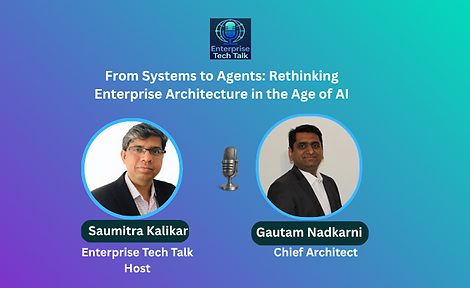
From Systems to Agents : Rethinking Enterprise Architecture in the Age of AI - with Gautam Nadkarni
For decades, enterprise architecture has operated on a simple assumption: systems are predictable. Architects designed deterministic platforms with well-defined workflows, structured integrations, and clear boundaries. If the input was known, the output could be anticipated. Governance frameworks, testing strategies, and operating models were all built on this premise.
That assumption is now breaking down. As organisations adopt AI at scale, a new class of systems is emerging—agentic systems. These systems do not simply execute instructions. They perceive, reason, act, and adapt. In other words, they make decisions.
This shift is not incremental. It fundamentally changes what enterprise architecture means.
From Automation to Autonomy
Traditional automation followed predefined paths. Whether implemented through workflows, APIs, or microservices, the logic was explicit and predictable. Failure modes were clear, testing was deterministic, and governance was largely a design-time activity.
Agentic systems behave differently.
As discussed in the conversation with Gautam Nadkarni , these systems operate on a probabilistic model. They interpret context at runtime, determine execution paths dynamically, and may produce different outcomes for the same input depending on the surrounding context.
This introduces a new dimension of behavior:
Execution paths are no longer fixed—they emerge at runtime
Failures are not always binary—they can manifest as drift or hallucination
Testing is no longer about pass/fail—it becomes about confidence and evaluation
State is no longer transient—systems accumulate memory over time
In effect, enterprises are moving from systems that follow instructions to systems that interpret intent.
Why Enterprise Architecture Must Evolve
Most enterprise architecture frameworks assume determinism. Capability models, application portfolios, and integration patterns are built on the idea that systems behave consistently.
That assumption no longer holds. In an agent-driven world, architecture cannot stop at defining systems and interfaces. It must extend into governing behaviour.
Gautam described this shift powerfully: enterprise architecture is moving from cartography to air traffic control.
Previously, architects designed maps—static representations of systems and their interactions. Now, they must actively manage dynamic environments where systems continuously adapt, re-route, and make decisions in real time. This requires a fundamental rethink of architecture itself:
From static blueprints to dynamic control mechanisms
From design-time assurance to runtime governance
From system structure to system behaviour
Emerging Architecture Patterns for Agentic Systems
As organisations experiment with agentic systems, distinct architectural patterns are beginning to emerge.
The simplest model is the single-agent pattern, where one agent performs a bounded task. This is often the starting point for enterprises exploring AI.
More advanced implementations adopt an orchestrator pattern, where a central agent coordinates multiple specialised agents. This provides a balance between control and flexibility, making it suitable for enterprise environments where governance and predictability still matter.
At the other end of the spectrum is the decentralised swarm model, where agents collaborate dynamically without a central controller. These systems are highly scalable and adaptive, but significantly more complex to govern.
In practice, most enterprises are converging towards a hybrid model—combining orchestration with selective decentralisation.
What sits above these patterns is equally important.
A modern agentic architecture introduces three critical layers:
A control plane to enforce policies, security, and observability
A data and context plane to provide relevant information for decision-making
An execution plane where agents interact with tools and systems
This layered approach shifts architecture from application-centric design to ecosystem orchestration.
Data as the New Competitive Advantage
One of the most profound shifts discussed in the episode is the role of data.
In traditional systems, competitive advantage often came from application logic. In agentic systems, it comes from context.
Two organisations can use the same underlying AI model and produce vastly different outcomes depending on the quality, depth, and timeliness of the data they provide.
This elevates data architecture to a central role. Enterprises must move beyond batch-oriented data platforms and build capabilities such as:
Vector-based retrieval for semantic understanding
Embedding strategies to structure contextual knowledge
Real-time pipelines to continuously refresh context
Equally important is how memory is managed. Agentic systems rely on multiple layers of memory:
Working memory for immediate context
Episodic memory for session-level interactions
Semantic memory for organisational knowledge
Each layer introduces different governance challenges, particularly around privacy, access control, and data retention.
Rethinking Governance in an Autonomous World
Governance is where the implications of agentic systems become most visible. In deterministic systems, governance is largely preventive. Systems are reviewed, approved, and deployed with confidence that they will behave as designed.
In agentic systems, that model breaks down. Behaviour can only be fully understood at runtime. As a result, governance must shift from gatekeeping to continuous oversight. Three mechanisms become critical:
Policy as code, where guardrails and access controls are embedded into the system
Continuous evaluation, ensuring behaviour remains within acceptable limits in production
Human-in-the-loop controls, particularly for high-risk decisions
This is not just a technical shift. It is a change in how organisations think about accountability. Enterprises are no longer governing systems. They are governing decisions made by systems.
Integrating with the Real Enterprise
Despite the rise of agentic systems, enterprise landscapes are not being rebuilt from scratch.
ERP platforms, CRM systems, and industry applications remain central to operations. The challenge is integrating agentic capabilities without compromising the integrity of these systems. The emerging approach is a federated model, where:
Core platforms embed native AI capabilities
External agents extend functionality and orchestrate workflows
Both operate within a governed ecosystem
This allows organisations to innovate at the edge while maintaining control at the core.
A Practical Roadmap for Enterprises
For most organisations, the journey to agentic systems is not a single leap. It is a progression. The first step is augmentation, where AI enhances existing processes. This is followed by semi-autonomy, where agents take on more responsibility within controlled boundaries. The final stage is autonomy, where end-to-end processes are reimagined around agent-driven execution.
Each stage requires new capabilities—in architecture, governance, and operating models.
The Future of Enterprise Architecture
Perhaps the most important takeaway from this conversation is the changing role of the architect. Enterprise architecture is no longer about documenting systems. It is about continuously shaping and governing dynamic ecosystems. Architects must move:
From design to operation
From static reviews to continuous evaluation
From system thinking to behavioural thinking
New roles are already emerging—agent architects, AI platform engineers, evaluation specialists. But more fundamentally, the mindset of architecture is shifting. The architect is no longer just a designer of systems. They are becoming the steward of autonomous enterprise behaviour.
Final Reflection
Agentic systems are not just another technology trend. They represent a structural shift in how enterprises operate. The question is no longer how to build systems. It is how to design, guide, and govern systems that can think and act on their own.