
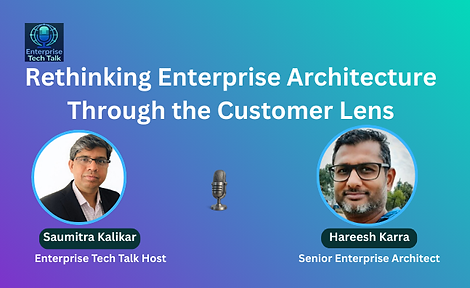
Rethinking Enterprise Architecture Through the Customer Lens - with Hareesh Karra
For years, customer experience was treated as a front-end concern — a better UI, a smoother mobile app, or a redesigned website. But in today’s digital-first world, that mindset is no longer sufficient.
Customer experience is now an end-to-end enterprise architecture problem.
In the latest episode of the Enterprise Tech Talk Podcast, I sat down with Hareesh Karra, a seasoned Senior Enterprise Architect, to unpack what customer-centric enterprise architecture really means — and why many organisations struggle to make it real despite years of investment.
The Customer-Centricity Paradox
Almost every organisation claims customer centricity as a strategic priority. Yet in practice, many enterprises are still organised around:
- Internal silos
- Legacy systems
- Fragmented data
- Technology-first operating models
As Hareesh points out, the gap is widening because customer expectations have fundamentally shifted. Customers now expect:
- Digital-first engagement as the default
- Trust in how their data is used and protected
- Low effort, fast resolution, across every channel
At the same time, organisations face increasing cost-to-serve pressures, regulatory complexity, and declining customer tolerance for poor experiences. This tension is precisely why customer centricity remains so hard to achieve.
The Mindset Shift for Enterprise Architects
One of the strongest themes from the discussion is that enterprise architecture must evolve beyond its traditional boundaries.
- Customer-centric enterprise architecture requires a shift:
- From technology standards to customer outcomes
- From application portfolios to customer journeys
- From abstract capability models to value-driven investment decisions
Instead of asking, “What systems do we need?”, architects must start with:
- What experience are we trying to deliver?
- Where are the moments of truth for the customer?
- Which capabilities directly enable those moments?
This reframing positions enterprise architects not just as advisors, but as active decision-makers shaping product roadmaps and business outcomes.
Why Value Streams and Journeys Matter More Than Ever
A particularly practical insight from the episode is the power of combining:
- Customer journeys
- Value streams
- Capability models
Many organisations already have capability maps — but they often remain static artefacts. When journeys and value streams are mapped to those capabilities, they become actionable intelligence.
This approach enables leaders to:
- Identify friction, duplication, and handoffs
- Quantify where technology truly adds customer value
- Prioritise investments based on customer impact, not intuition
It also changes the conversation with business stakeholders — from “What does this system do?” to “This capability directly underpins our most critical customer journey.”
Architecture Patterns That Enable Customer Centricity
From a technology perspective, the episode highlights a major architectural shift: the emergence of the customer data layer.
Unlike traditional data warehouses built for reporting, modern customer data platforms support:
- Near real-time, transactional engagement
- Omni-channel consistency
- Personalisation at scale
Combined with API-led, composable architectures, this pattern enables enterprises to deliver coherent experiences across channels — without rebuilding everything from scratch.
Measuring What Actually Matters
Another key takeaway is the need to move beyond NPS as the sole measure of customer experience.
More meaningful metrics include:
- Customer effort (time and friction to complete tasks)
- First contact resolution
- Trust indicators, such as data handling and transparency
Complaint trends, not just satisfaction scores
These metrics align far more closely with architectural decisions and provide tangible feedback on whether customer-centric design is truly working.
The Role of AI in Customer-Centric Architecture
AI, particularly agent-based and generative AI, emerged as an accelerator rather than a bolt-on capability.
The most immediate value is being realised in:
- Customer service enablement
- Frontline agent augmentation
- Workflow automation and orchestration
Crucially, AI works best when treated as part of existing value streams — not as a standalone innovation initiative.
A Practical Starting Point
If there is one piece of advice enterprise leaders should take away, it is this:
Start with one high-value, high-volume customer journey.
Map it end-to-end.
Understand the capabilities behind it.
Improve it measurably — then scale.
Customer-centric enterprise architecture is not a theoretical exercise. It is a disciplined, outcome-driven evolution of how we design enterprises for the customers they serve.
🎙️ Listen to the full episode of Enterprise Tech Talk to explore these insights in depth and hear practical guidance from real-world experience.