
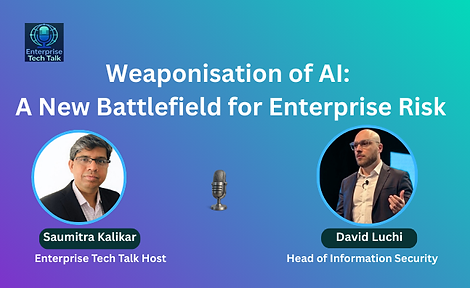
Weaponisation of AI - A New Battlefield for Enterprise Risk
AI is no longer just accelerating innovation. It’s accelerating conflict.
In the latest episode of Enterprise Tech Talk, Saumitra Kalikar sat down with David Luchi , Head of Information Security at Flybuys, to unpack a reality many organisations are still reluctant to confront: artificial intelligence is already being weaponised — and enterprises are now on the front line.
This conversation wasn’t about science fiction or autonomous weapons. It was about what’s already happening today across cyber operations, information warfare, and economic disruption — often at a speed that traditional enterprise controls simply can’t match.
One of the strongest themes to emerge from the discussion was how AI has collapsed the gap between attacker sophistication and impact. Capabilities that once required nation-state resources are now accessible to a much broader set of actors. Phishing campaigns are hyper-personalised at scale. Malware adapts in real time. Social engineering is no longer generic — it’s targeted, contextual, and highly convincing.
As David highlighted, the challenge for enterprises isn’t just an increase in attacks — it’s a fundamental change in the nature of the threat.
Increasingly, the target isn’t just systems or data. It’s trust.
AI-driven impersonation, deepfakes, and narrative manipulation are undermining confidence in identity, leadership credibility, and decision-making. In many cases, organisations can suffer reputational or financial damage long before a traditional security alert is triggered.
Another critical insight from the episode was this: enterprises are not just collateral damage in geopolitical conflict — they are proxy battlegrounds.
Nation-states and organised actors are embedding themselves inside commercial platforms, cloud ecosystems, and supply chains. Data-rich organisations — including loyalty platforms, financial systems, and digital identity providers — have become strategic assets. As David noted, neutrality is no longer a meaningful defence posture.
What makes this especially challenging is that many enterprise security and governance models were never designed for a world where AI itself can be hostile. Perimeter-based controls, human-paced response processes, and fragmented ownership struggle to keep up with machine-speed threats.
So what does preparedness actually look like?
A clear message from the conversation was the need for a shift:
Treating AI risk as a core business and board-level risk, not just a technology issue
Embedding secure-by-design principles into AI architectures, rather than bolting controls on later
Strengthening governance across data, models, usage, and accountability
Designing for resilience, not just prevention, in recognition that disruption is inevitable
Perhaps the most important takeaway from the discussion was this:
The organisations that succeed in the AI era won’t be the ones with the most AI — but the ones that can govern it, secure it, and respond at machine speed.
If you’re a board member, CIO, CISO, architect, or technology leader navigating AI adoption today, this is a conversation you can’t afford to ignore.
🎙️ Listen to the full episode of Enterprise Tech Talk, hosted by Saumitra Kalikar , featuring David Luchi , Head of Information Security at Flybuys, to explore how AI is being weaponised — and what your organisation must do to prepare.