
Product, Platform or Capability? Resolving the Operating Model Confusion in Enterprise Technology
Saumitra Kalikar
By Saumitra Kalikar · Updated 21 July 2026 · 9 min read
Many enterprise technology organisations are now fluent in the language of products, platforms and capabilities. Yet, in practice, these terms are often used interchangeably, leading to ambiguity in decision-making and misalignment in execution.
A customer journey team may position itself as a product team. A shared API is labelled a platform. A business function is reframed as a capability. Over time, the operating model risks becoming a collection of fashionable constructs rather than a disciplined framework for allocating capital, governing delivery and realising value.
This ambiguity is no longer benign. As organisations scale digital delivery, modernise legacy estates and embed AI into core operations, unclear distinctions between products, platforms and capabilities manifest in tangible inefficiencies: duplicated engineering effort, fragmented ownership, inconsistent governance, limited reuse and persistent funding contention.
The leadership challenge is not deciding whether to organise around products, platforms or capabilities. These are not competing operating models. They are complementary constructs that serve different purposes. The real challenge is defining their roles clearly and integrating them into a cohesive operating model that delivers strategic, operational and technology outcomes.
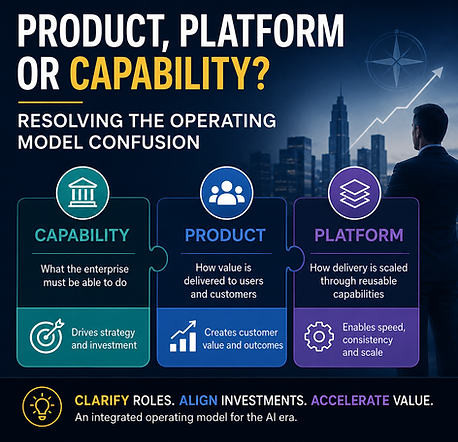
Capabilities define the enterprise. Products deliver value. Platforms create scale.
A capability articulates what the organisation must be able to do to execute its strategy. Examples include customer onboarding, payments, pricing, identity verification, claims management and fraud detection. Capabilities are business-oriented, relatively stable and serve as a foundation for strategic investment planning.
A product defines how value is delivered to a customer, employee, partner or internal user. Digital banking applications, claims portals, sales workflows, developer portals and AI assistants qualify as products when they have clearly defined users, measurable outcomes, accountable ownership and lifecycle governance.
A platform represents the reusable technology, services and guardrails that enable multiple products or teams to deliver more efficiently and consistently. Identity, data, AI, integration, observability and developer experience are typical platform domains.
Each construct addresses a distinct executive question:
Capability: What must the organisation excel at?
Product: Who are we serving, and how do we measure value?
Platform: What should be standardised and reused to drive efficiency and scale?
When these constructs are conflated, organisations either over-centralise in pursuit of reuse or over-decentralise in the name of autonomy—both of which erode value.

Operating model relationship: business capabilities guide products and platforms, which combine to deliver enterprise outcomes.
“Capabilities provide strategic clarity. Products create value. Platforms create leverage.”
Why the confusion has intensified
Enterprise operating models have evolved in successive waves—from project-based delivery to agile, then to product-centric models, followed by platform engineering and now AI-enabled operating models. Each evolution introduced valuable concepts, but often without consistent definitions or governance frameworks.
As a result, many organisations now operate with “products” lacking economic accountability, “platforms” without defined internal customers and “capabilities” that are little more than rebranded applications.
Empirical evidence underscores the importance of resolving this ambiguity. McKinsey’s analysis of over 400 public companies demonstrates that organisations with mature product and platform operating models outperform peers on key financial metrics, including total shareholder returns and operating margins. The research highlights funding models, technical debt management and cross-functional alignment as critical differentiators (McKinsey – The bottom-line benefit of the product operating model).
For CIOs and CTOs, this is not a matter of terminology—it is a determinant of enterprise value realisation.
“An operating model cannot succeed if its vocabulary means something different to every executive.”
Product engineering and platform engineering are distinct disciplines
A common misconception is that platform engineering is simply an extension of product engineering applied to technical assets. In reality, the disciplines serve fundamentally different purposes.
Product engineering focuses on differentiated user outcomes—customer experience, market responsiveness, feature evolution and commercial performance. It is concerned with the experiences, services and workflows that customers, employees or partners directly consume.
Platform engineering, by contrast, is designed to reduce friction for internal teams. Its primary objective is to minimise cognitive load, standardise repeatable patterns and enable faster, more reliable delivery across the organisation.
DORA defines platform engineering as a sociotechnical discipline centred on automation, self-service and repeatability through internal developer platforms and “golden paths” (DORA Platform Engineering). Similarly, Martin Fowler’s interpretation of Team Topologies emphasises the role of platforms in reducing cognitive load for stream-aligned teams (Martin Fowler – Team Topologies).
This distinction has direct implications for performance measurement. Customer-facing products are evaluated on metrics such as adoption, retention, revenue contribution and customer satisfaction. Platforms, however, should be assessed based on internal adoption, reduction in duplication, deployment frequency, reliability, developer experience and time-to-market improvements.
A technically sophisticated platform that is underutilised is not successful. A platform that is widely adopted because it simplifies and accelerates delivery is.
“Product engineering creates differentiated experiences. Platform engineering removes friction from creating those experiences.”
Platforms should be treated as internal products—but not as conventional products
The concept of “platform as a product” is directionally correct but often oversimplified.
Platforms require product management discipline: defined users, roadmaps, service levels, adoption targets and feedback loops. Gartner anticipates that platform engineering teams will become standard across large enterprises, acting as internal providers of reusable services and tooling (Gartner – Platform Engineering).
However, platforms differ from traditional products because they operate at the intersection of product management, enterprise architecture, engineering standards, security and financial governance.
An effective platform operating model typically includes:
A platform product manager aligned to internal customer needs
Engineering leadership accountable for reliability and scalability
Architectural oversight to ensure long-term coherence
Developer experience capabilities to drive adoption
Embedded security and compliance controls
FinOps discipline for cost transparency
A structured engagement model with consuming teams
Simply assigning a product owner and maintaining a backlog is insufficient. Platform teams must actively manage adoption, standards, support and continuous evolution.
The best internal platforms are adopted because they make delivery easier, safer and faster—not because governance mandates their use.
“The best enterprise platforms become the easiest path, not merely the mandatory path.”
The funding model must evolve
Funding is where operating model design translates into execution reality.
Traditional project-based funding is inherently misaligned with platform sustainability. While it may support initial build or transformation initiatives, it does not provide the continuity required for ongoing platform evolution.
Product-based funding models offer a more effective alternative by enabling persistent teams and continuous delivery. McKinsey emphasises that product and platform teams should be funded against measurable outcomes, with autonomy to manage backlogs and technical debt (McKinsey – The big product and platform shift).
For enterprise platforms, a hybrid funding model is typically most effective:
1. Strategic capability funding: Core platforms underpinning enterprise-wide capabilities such as identity, data, integration, AI and developer experience, should receive baseline funding as strategic enterprise assets.
2. Persistent product-style funding: Platform teams should operate as enduring teams with clearly defined outcomes and roadmaps.
3. Consumption transparency: Where usage drives cost, mechanisms such as showback or chargeback should provide visibility without introducing unnecessary complexity.
4. Co-investment models: Significant platform enhancements driven by specific product needs should be co-funded, balancing enterprise benefit with local demand.
The guiding principle is: platforms should be funded based on the enterprise capabilities they enable, not on isolated project demand.

Hybrid platform funding combines strategic baseline investment, consumption transparency, co-investment and optional extension funding.
“Project funding may build a platform. It rarely sustains one.”
AI raises the stakes
The emergence of AI amplifies the consequences of operating model ambiguity.
Without a coherent platform strategy, organisations risk fragmented AI implementations—each product team independently selecting models, defining governance and managing risk. This leads to duplication, inconsistency and heightened exposure.
AI requires a set of shared enterprise capabilities: model access, data grounding, evaluation frameworks, observability, governance controls, policy enforcement, identity, auditability and cost management. These are inherently platform concerns.
At the same time, value realisation occurs at the product layer—through enhanced customer experiences, improved operational efficiency, employee productivity and new revenue streams.
DORA’s 2024 report highlights that while AI adoption is widespread and associated with productivity gains, it does not automatically translate into improved delivery performance without strong engineering fundamentals and governance (DORA 2024 Report).
For senior leaders, the implication is obvious. AI must be embedded within the operating model, with clear delineation between product innovation and platform enablement.
Product teams should identify where AI can improve user outcomes. Platform teams should provide the reusable foundations for safe and scalable AI adoption. Capability planning should determine where AI creates strategic differentiation and where standardisation is more appropriate.
“AI increases the cost of duplication and raises the value of well-governed enterprise platforms.”
Case studies: leading practices in action
Spotify’s Backstage exemplifies platform thinking applied to developer experience. Backstage provides a unified developer portal, enabling standardisation of tooling, documentation and workflows across engineering teams (Backstage by Spotify). The platform demonstrates how internal capabilities can be productised to improve engineering productivity at scale.
Netflix offers a complementary perspective through its “paved road” approach—formally supported tools and practices that are not mandated but are inherently more efficient than alternatives (Netflix Tech Blog – Paved Roads). Netflix’s experimentation platform further illustrates how reusable capabilities can enable innovation across product teams (Netflix Tech Blog – Experimentation).
DBS provides a broader enterprise transformation example. Its transition to a technology-led operating model, supported by modern platforms and AI capabilities, has been well documented by McKinsey (McKinsey – DBS Transformation) and DBS itself (DBS AI Transformation).
These examples reinforce a consistent theme: successful organisations align capabilities, products and platforms within a coherent operating model. They do not rely on terminology alone. They clarify ownership, fund persistent teams, create reusable foundations and measure adoption.
“The strongest digital organisations do not choose between autonomy and standardisation. They design for both.”
How CIOs and CTOs should respond
Resolving this ambiguity requires deliberate design.
Establish a clear enterprise capability map to guide strategic investment and prioritisation. This should be more than an architecture artefact. It should become a shared language for investment planning, transformation sequencing and executive decision-making.
Define products based on user outcomes, with explicit accountability for value delivery. Not every application is a product. Not every agile team is a product team.
Define platforms based on reuse and leverage, with measurable impact on efficiency, consistency and scalability. A platform should have multiple consumers, a service model, adoption strategy, roadmap, support model and measurable contribution to enterprise outcomes.
Align funding models to reflect these distinctions. Products should be funded for value delivery. Platforms should be funded for enterprise leverage. Capabilities should guide where investment matters most.
Finally, implement governance that enables transparency and alignment without constraining innovation. The goal is not to centralise every decision. The goal is to make the right decisions visible.
“Governance should clarify where autonomy creates value and where reuse creates scale.”
Conclusion: an integrated operating model is the differentiator
The future operating model is not a choice between products, platforms or capabilities. It is an integrated model that leverages all three. Capabilities provide strategic direction. Products deliver differentiated value. Platforms enable scale and efficiency.
For CIOs, CTOs and senior executives, the challenge is to orchestrate these elements into a cohesive system that drives sustained value creation.
In the AI era, this alignment becomes even more critical. Organisations that successfully combine product innovation with platform-enabled scale will outperform those that allow fragmentation to persist.
The question is no longer which construct to adopt. The question is how effectively products, platforms and capabilities are integrated, governed and funded to deliver enterprise outcomes.